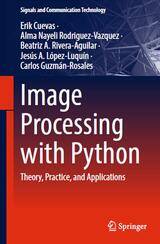
The objective of this book is to provide comprehensive material tailored to students and professionals studying image processing. Designed to support both theoret-ical learning and practical implementation, it covers a broad spectrum of essen-tial topics. These include foundational concepts such as pixel-level operations and geometric transformations as well as advanced techniques such as spatial filtering, image segmentation, edge detection, and color image processing. By integrating detailed explanations with practical examples, the book aims to equip readers with a deep understanding of image processing methods and their real-world applications, making it an invaluable guide for mastering the subject.
Read, Display, and Write Images.
Until a few years ago, the image processing and computer vision community was a relatively small group with access to costly processing tools or experts in some programming languages. Today, many libraries facilitate designing vision systems, whether for manufacturing inspection applications or navigating a mobile robot. An example of such a tool is OpenCV.
OpenCV is an extensive open-source library for computer vision, machine learning, and image processing. It supports various programming languages, including Python, C++, and Java. With OpenCV, you can process images and video to recognize objects, faces, or even human handwriting. The range of available func-tionality expands when integrated with other libraries, such as NumPy (a highly opti-mized library for numerical operations). Any operation you can perform in NumPy can be seamlessly combined with OpenCV, greatly expanding your toolkit [3].
Contents.
1. Introduction.
1.1. Vision and Image Processing System.
1.2. Digital Image Processing.
1.3. Basic Pixels Relationships.
1.3.1. Neighbors of a Pixel.
1.3.2. Connectivity.
1.4. Distance Measurements.
1.5. Read. Display, and Write Images.
References.
2. Pixel Operations.
2.1. Pixel-Wise Intensity Adjustment.
2.1.1. Brightness and Contrast Variations.
2.1.2. Boundary Definition Through Pixel-Level.
Processing.
2.1.3. Pixel Inversion.
2.2. Pixel Operations in Python.
2.2.1. Contrast and Illumination Change in Python.
2.2.2. Complement of an Image with the Python.
2.2.3. Composite Pixel Transformations.
2.2.4. Boolean and Mathematical Computations.
2.2.5. Alpha Mixing Operations.
References.
3. Geometric Operations in Images.
3.1 Coordinate Transformation.
3.1.1. Basic Transformations.
3.1.2. Homogeneous Coordinates.
3.1.3. Affine Transformation (Triangle Transformation).
3.2. Implementing Geometric Transformations in Python.
3.2.1. Translation of an Image with Python.
3.2.2. Scaling of an Image with Python.
3.2.3. Inclination of an Image with Python.
3.2.4. Rotation of an Image with Python.
References.
4. Histograms.
4.1. Definition of a Histogram.
4.2. Fundamentals of Image Acquisition.
4.2.1. Illumination Issues.
4.2.2. Contrast Properties.
4.2.3. Concept of Dynamics.
4.3. Cumulative Histogram.
4.4. Computing Image Histograms Using Python.
4.5. Image Histograms and Point Processing Techniques.
4.6. Auto-enhancement of Image Contrast.
References.
5. Spatial Filters.
5.1. Understanding Image Filters.
5.2. Spatial Linear Filters.
5.2.1. The Filter Matrix.
5.2.2. Filter Operation.
5.3. Implementing Filter Operations in Python.
5.4. Types of Linear Filters.
5.4.1. Smooth Filters.
5.4.2. Difference Filters.
5.5. Formal Characteristics of Linear Filters.
5.5.1. Linear Convolution and Correlation.
5.5.2. Properties of Linear Convolution.
5.5.3. Separability of Filters.
5.5.4. Filter Impulse Response.
5.6. Spatial Nonlinear Filters.
5.6.1. Maximum and Minimum Filters.
5.6.2. The Median Filter.
5.6.3. The Median Filter with Multiplicity Window.
5.6.4. Other Nonlinear Filters.
References.
6. Edges and Contours.
6.1. How Are Contours Produced?.
6.2. Methodologies Based on the Gradient for Edge Detection.
6.2.1. Calculation of Gradient for Edge Detection.
6.2.2. Derivative Kernel.
6.3. Filters for Edge Detection.
6.3.1. Operators Prewitt and Sobel.
6.3.2. The Roberts’ Filter.
6.3.3. Compass Operators.
6.4. Edge Detection with Python.
6.4.1. Using Python as a Programming Language to Find Edges.
6.5. Second-Derivative Edge Filters.
6.5.1. Second-Derivative Method for Edge Detection.
6.6. Improved Image Sharpness.
6.6.1. The Laplacian Filter for Image Sharpness Enhancement in Python.
6.7. Canny Filter.
6.7.1. Implementing the Canny Filter with Python.
References.
7. Determination of Corners.
7.1. Intersection Points of Prominent Edges.
7.2. Harris Corner Detection Method.
7.2.1. Structure Matrix.
7.2.2. Matrix HE Spectral Filtering.
7.2.3. Eigenvalue-Eigenvector Extraction.
7.2.4. Corner Response Measure (V).
7.2.5. Corner Point Identification and Localization.
7.2.6. Algorithm Coding and Execution.
7.3. Python-Based Corner Point Detection.
References.
8. Detection of Lines and Curves.
8.1. Detection of Structural Elements in Images.
8.2. Detecting Parametric Shapes with the Hough Transform.
8.2.1. Representation in Parameter Space.
8.2.2. Voting Matrix in Hough Space.
8.2.3. Modifying the Parametric Representation.
8.3. Implementation of Line Detection via Hough Transform.
8.4. Line Detection Using the Hough Transform in Python.
8.5. Detection of Circular Features via Hough Transform.
8.6. Hough Transform for Circle Detector Implemented in Python.
References.
9. Image Segmentation.
9.1. Segmentation.
9.2. Thresholding.
9.2.1. Ideal Case: Separated Distributions.
9.2.2. Real Case: Overlapping Distributions.
9.2.3. Improving Segmentation: Median Filter.
Preprocessing.
9.3. Calculating the Optimum Threshold.
9.4. Otsu Algorithm.
9.4.1. Mathematical Formulation.
9.5. Region-Growing Segmentation.
9.5.1. Initial Pixel Selection.
9.5.2. Local Search.
References.
10 Morphological Operations.
10.1. Contraction and Growth of Structures.
10.1.1. Types of Neighborhoods.
10.2. Fundamentals of Morphological Operations.
10.2.1. The Reference Structure.
10.2.2. Set of Points.
10.2.3. Dilatation.
10.2.4. Erosion.
10.2.5. Dilatation and Erosion Properties.
10.2.6. Morphological Filter Design.
10.3. Edge Detection in Binary Images.
10.4. Combination of Morphological Operations.
10.4.1. Opening.
10.4.2. Closing.
10.4.3. Properties of Opening-and-Closing Operations.
10.4.4. The “Hit-or-Miss” Transformation.
10.5. Morphological Operations for Grayscale Images.
10.6. Reference Structure.
10.6.1. Dilatation and Erosion for Grayscale Images.
10.6.2. Opening-and-Closing Operations for Grayscale Images.
10.7. Implementation of Morphological Operation in Python.
References.
Бесплатно скачать электронную книгу в удобном формате, смотреть и читать:
Скачать книгу Image Processing With Python, Cuevas E., 2026 - fileskachat.com, быстрое и бесплатное скачивание.
Скачать файл № 1 - pdf
Скачать файл № 2 - epub
Ниже можно купить эту книгу, если она есть в продаже, и похожие книги по лучшей цене со скидкой с доставкой по всей России.Купить книги
Скачать - epub - Яндекс.Диск.
Скачать - pdf - Яндекс.Диск.
Дата публикации:
Хештеги: #учебник по программированию :: #программирование :: #Cuevas
Смотрите также учебники, книги и учебные материалы:
Следующие учебники и книги:

Предыдущие статьи: